A Certain Sense of Place
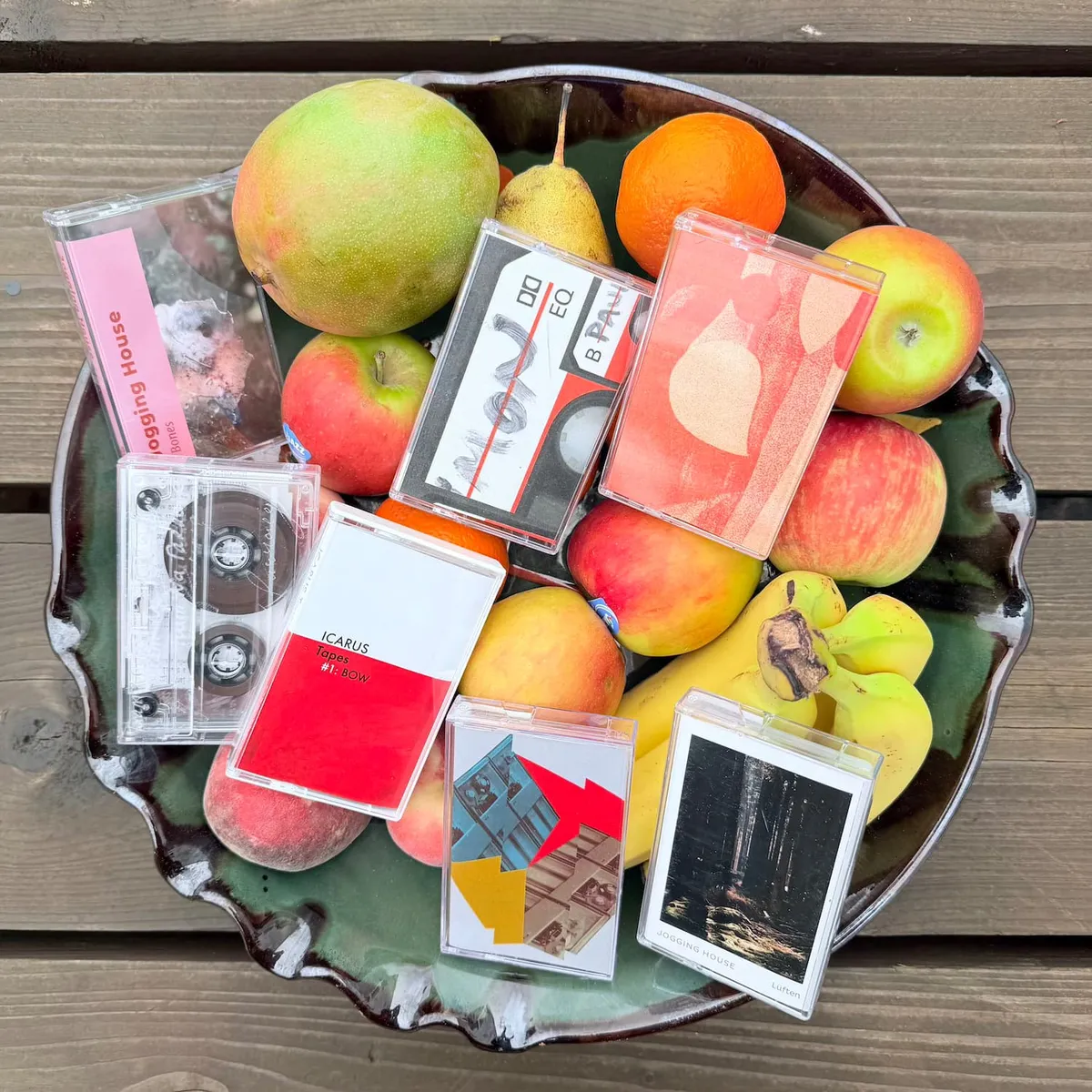
Audio Version
Listen to the episode on Mixcloud
Written Version
In this episode
- Janitor – Jogging House
- animus lop. (p.s.) – Steve Roden
- aprile 26 – deeb
- Live at Icarus (Part I) – BOW
- Side B (ii) – metaxu
- Houses Tilting Towards the Stars – akira film script
- Recently – Jogging House
Janitor – Jogging House
The last episode brought the good vibes. And maybe you started this episode and you’re there, aww yeahh here we go, another Fionntán & Tapes. We've got a big summer road trip coming so let's blast out the tuuuunes. And then you turn this on and you go…is this..is this ambient music? Is this German ambient music?? This is anti-craic!
We'll get through it though. We just need to change pace and sidle up to this show, don't look directly at it, whisper to it gently.
First, the artist himself there. That's Jogging House, Boris Potschubay, “a synthesist and composer from Frankfurt, Germany with a free approach to composition and a relaxed, sensual sound”. Especially so since his profile photo on Bandcamp is him petting a couple of donkeys.
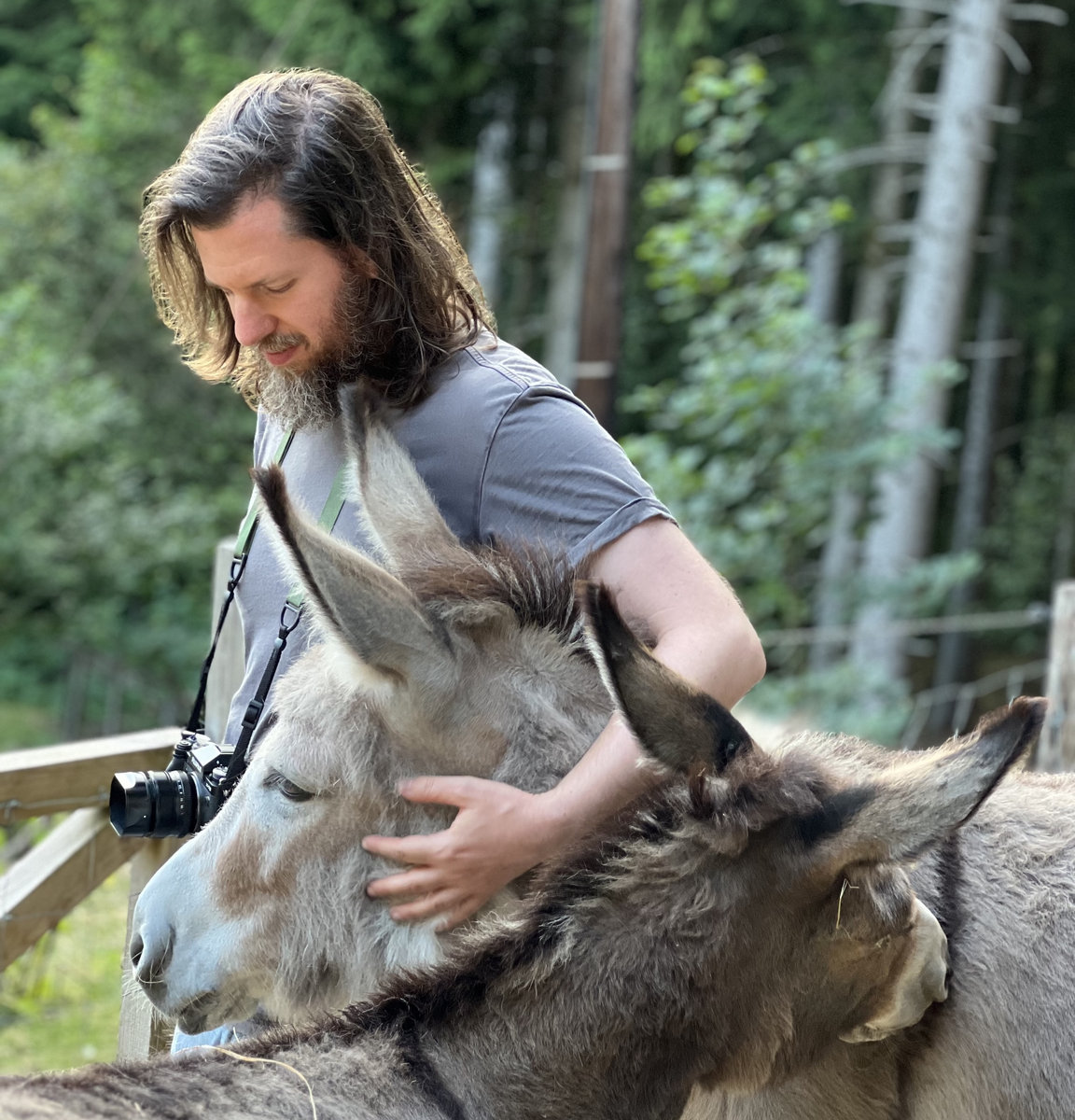
He runs a record label called Seil Records. There's a whole load of different ambient artists on there and all the albums on this record label1 are for sale on cassette – so he's a man after my heart.
seil records is a community of electronic musicians, who took on the seemingly impossible task of making the world a more optimistic place.
I don't want to be reductive and call all the music on this episode ambient but I struggle for a better name. It's slow electronic music that isn't entirely melody driven. Atmospheric music? Environmental music? You just know when you hear it.
I don’t have as much backstory on artist bios today. One, there’s not much out there – these artist tend to be of the quiet type. Two, sometimes it's good not to know. I like the idea that this music just comes from the ether, it arrives to us from some unknown place. Even the artists don’t really want us to know, like imagine how strange it would be if some ambient artist was on the cover of an album and they had on skinny jeans and a t-shirt and leaning against a Mustang. Actually, it’d great lol.
I'll start off this episode by giving my thoughts on this music.
It's not exactly foreground music, it feels passive. It's often electronic but it tends not to be harsh on the ear or abrasive. What I learned through properly listening to this stuff over the last month with headphones on is that you can 100% ignore the music and just let it waft through the room2 but you can also intensely listen to it.
When ambient music is good (and I think all the tracks here are good), there's enough going on that you can sit there and watch it unfold like it’s a short film. In the car I just enjoy properly paying attention to these songs. Listening to these tracks intently, even just a minute or two at a time, and just focusing on the different layers as they slowly roll along. It's not like a pop song with lyrics and chords and ten instruments flying by, it’s slowed down to more of a human pace3. With this music, maybe because of its slow down pace, you can analyse it in real time like you're walking through the countryside as opposed to zipping by in a car. Even if it is just these sine waves or drone comes in once every few minutes.
I don't know a lot about art-art and but I remember reading something from Mondrian – the French guy with the minimal red and blue lines and squares in his paintings. He said, I’m just doing what everyone else does with lines and angles but I’m just pairing it all right back.
Another huge thing with ambient is that time and space can be (could be? should be?) considered along with the environment you're in. There's no real silence, there's always something going on. Could be traffic or birds or the kitchen fan or even just your own body huffing and breathing and squelching. Imagine if there was an artwork and you had to consider the room or the museum that it’s in – like a couch facing could be part of the artwork because it affects the perception.
It doesn’t draw attention to itself directly, the music gives you enough space to consider everything around it, the other sounds in the room. Take this show right here. You're listening but what's your body doing? Are you standing? Are you sitting? Washing dishes? Are you in the car or is the car in the city? The countryside? Are you on a run? Doesn't all that affect your perception of what you're listening to?
What I’m saying is there’s a (show title alert) certain sense of place with this music.
There's a good anecdote about Eric Satie who's this late-19th early-20th century French composer. He made this ‘musique d’ameublement’ (furniture music). He spoke of:
“music which would be part of the ambience, which would take account of it. I imagine it being melodic in nature: it would soften the noise of knives and forks without dominating them, without imposing itself.”
He writes these pieces and performs them live and he tells the audience to just chat, ignore the music, just let it happen in the background. But they would they won't do it, they keep paying attention. He goes, no no no, you’ve got to not listen to the music!4
I would say it's an extremely tape friendly-medium. You could play one song but it’s more enjoyable if you take this music in blocks or big chunks of 20 or 30 minutes like the side of a tape. It's reflected in who is selling on Bandcamp. There's so many ambient people on there and ambient fans. Even on this Seil Records, it’s great to see so many of their albums are sold out. It also works with the tape hiss that's slightly interfering with the song but maybe it adds a certain layer to it that becomes a part of the song, a part of the environment of the music.
I have some reservations about this music though. Sometimes you're there and you have it on and just go feck this, you get this urge to put something properly exicting on instead. Let’s rock out, let’s gooooo. At its worst the music is too safe, too calm, relaxing, boring, stilted, everything that art isn't supposed to be.
But when it's good it can be something transcendent, something that can really make you reconsider what is music, what is listening, and bypass all your upper cortex, good melody ideas about a song and make you feel things you don't entirely understand. It’s music that can burrow itself in your head and unlock memories and that is what makes it such an interesting music to me and hopefully to you too.
04:40-12:17 of animus lop. (p.s.) – Steve Roden
This is less wavey and more loopy – as in, things on a loop. Although what's the difference between a loop and a wave? Cause a wave is a frequency on a loop. Hmm.
Anyway, Steve was a proper artist-artist from Los Angeles. He worked in sound art and visual arts and has a lovely site of some of his photography. Sadly he passed away in 2023 at just the age of 59 but he really left his mark in experimental sound art.
This episode asks what is ‘music’? What can music be? Artists like Steve explore that. He pioneered a genre called lowercase music. It's where you take very quiet sounds and then amplify them to an extreme level using analog equipment. That was a through line to a lot of his work – that hidden in all these everyday objects around us there's music or sound waiting to be unlocked or heard.
His quote, it’s music that:
bears a certain sense of quiet and humility; it does not demand attention, it must be discovered. the work might imply one thing on the surface but contain other things beneath. … it’s the opposite of capital letters—loud things which draw attention to themselves.
One of his works was for a gallery where he put mics up in the window of the gallery and collected sounds from the window, whether the window was open or closed, and then amplified those and played those in the gallery.
His most famous (in the art experimental sound world sense) was Forms of Paper. He was commissioned to do sound installations for libraries and in the liner notes he says:
i was given an atrium space to work with at a large Hollywood Branch library. i ended up using a low flat pedestal, the size of a big coffee table, which i covered in modified pages from a discarded science book. the pages were modified by folding them up into small squares and punching holes in them to create dot patterns that, when unfolded, resembled archaic rorschach ink blots (i.e. they contained a lot of mirror imaging). the speakers rested upon the layer of modified papers, playing a quiet composition that was soft enough that the sound never reached the upstairs area, which was the main portion of the reading spaces. while no one ever complained about the sound being distracting, one person did offer an anonymous response in the form of collaboration by inserting a small chinese electronic toy which made cricket sounds in a bookcase close enough to the installation that both could be heard at the same time.
I like how he named the style of lowercase music but it also got out of hand as it's just a casual description he used. Trying to name genre defines it but also gets in the way of enjoying music.
His words from the same notes:
what was interesting about the lowercase scene at the beginning was that on one hand it was quite positive, with a group of artists coming together locally and internationally simply because they were interested in quiet music and for many of us, it simply opened the conversation to a place of potential and experimentation. on the other hand, there was an element of conformity that drove me crazy, through endless debates about what was or wasn’t lowercase, including other media such as films or books. the conversations around such things felt meaningless, and worse it suggested that such a thing could be defined, and thus conformed to. while it was a nice sharing of influences and inspirations, it was clear that some folks began to try to make “lowercase music” rather than following their own path. nonetheless, as much as i continually grumbled at anyone using the term “lowercase music”, there were certainly many good things that came out of that scene.
On the music you heard above, maybe it’s best to start with the the cover of the tape. It's zoomed in pictures of two sides of a home cassette, one saying “chicago's best” and the other says “paul simon”. It seems that Steve has taken these two sides and cut them together to make this album. Also, I have cracked the code of the album title, it's the words ‘chicago’ and ‘paul simon’ smushed together to make: pcahuilcsaigmon.
The album was released on Farpoint Recordings5 who say they are:
“an independent Irish record label dedicated to adventurous, boundary-pushing work in contemporary music and sound art. We champion projects that invite deep, challenging and rewarding listening – works that explore the edges where composition, improvisation, sound art and audio-visual practice meet.”
The sleeve notes for this Steve Roden album are quite poignant. It's written by Steve (in lowercase letters) in this poetic short sentence style. Part of the note he's written:
discovery. a cassette tape in a box. the label on side A. my father's handwriting. in pencil: chicago's best. on side B. a few years later. my own hand. in felt tip pen: paul simon. …
my father left this planet many years ago. so what do i do. with such an offering.
…
i remember seeing. a lot in an auction. consisting of small pieces. of rotted wood. and rusted nails. these objects. seemed to have, lost their usefulness. but they were. pieces of george washington's coffin. so history plays a part. in determining. an object's resonance. like a talisman. whatever is imbued. remains in the object. and gives it power. transformation and alchemy. are part of any leap. of faith. my father and i. have left ourselves. upon the surface. of this object. so now i seek. those traces we have left. upon it. so that. chicago's greatest. and paul simon. can be like. the crushed detritus. of george washington's coffin.
…
rumpelstiltskin spun straw. into gold. but if my memory is true. he was also. capable of spinning. straw into straw, the same medium. in a different form. like same voices. heard differently.steve roden
aprile 26 – deeb
Just a lovely piece of music. Lovely tape box too, a reddy-orange-peach and the tape is this nice see-through orange.
About the album, camera uno:
Recorded in the quiet, suspended hours of a hospital in Turin, this collection captures fleeting moments of beauty, uncertainty, and new beginnings. Ambient soundscapes, textured with field recordings and distant melodies, trace a journey through melancholy, hope, and profound change. An intimate document of time standing still, where every sound feels like a breath between worlds.
And on Deeb:
a longtime explorer of electronic textures, draws inspiration from artists like Aphex Twin, Telefon Tel Aviv, and Björk, weaving emotion and experimentation into his work. His music reflects a deep connection to both the mechanical and the organic — synthesizers, field recordings, and human experience intertwined.
It comes from the Mabui Music label, an ambient experimental label based in…which possible city could they be in? You've guessed it, Berlin.
Deeb recorded this in hospital. You might be thinking, ambient + hospital = B.E.?? So, all right, let's get it out of the way, let's talk about Brian Eno.
I’ll start off by saying I’m not that much of an Eno person. He just doesn't give me the oomphs, he doesn't light my fire. I know he produced a lot of great albums but, well, he produced a lot of bland stinkers too for the likes of U2 and Coldplay, so, there’s that. And then he does these art projects and they seem okay, they got good concepts, they’re interesting to read about but I guess they don't make me feel a lot6.
On Brian Eno's album, Discreet Music, in ’75, this is in the liner notes.
In January this year I had an accident. I was not seriously hurt, but I was confined to bed in a stiff and static position. My friend Judy Nylon visited me and brought me a record of 18th century harp music. After she had gone, and with some considerable difficulty, I put on the record. Having laid down, I realized that the amplifier was set at an extremely low level, and that one channel of the stereo had failed completely. Since I hadn't the energy to get up and improve matters, the record played on almost inaudibly. This presented what was for me a new way of hearing music - as part of the ambience of the environment just as the colour of the light and the sound of the rain were parts of that ambience. It is for this reason that I suggest listening to the piece at comparatively low levels, even to the extent that it frequently falls below the threshold of audibility.
I'm probably going to disagree with old sourpuss Brian here. For these tunes today, you should absolutely blast them. Blast the bastards out loud. When a humming drone comes in it should really kick, it should start shaking the damn windows on your car.
The above is a founding myth story of ambient. But there's quite a few genres or movements that have a founding myth to them – Beatles at The Cavern or punk at CBGBs. I like this one about the origin of scratching records from Grand Wizzard Theodore.
I used to come home from school and go in my room and practice a lot and this particular day I came home and played my music too loud and my mom was banging on the door and when she opened the door I turned the music down but the music was still playing in my headphones and she was screaming 'If you don't turn the music down you better turn it off' and I had turned down the speakers but I was still holding the record and moving it back and forth listening in my headphones and I thought 'This really sounded something....interjecting another record with another record.' And as time went by I experimented with it trying other records and soon it became scratching.
There's also John Cage, the big experimental composer, silence was his thing. He has that piece where an orchestra plays nothing for four minutes 33 seconds and you just listen to the sounds in the concert hall. Anyway, that approach, that way of thinking, has a founding story to it also. From his lectures book, Silence.
There is always something to see, something to hear. In fact, try as we may to make a silence, we cannot. For certain engineering purposes, it is desirable to have as silent a situation as possible. Such a room is called an anechoic chamber, its six walls made of special material, a room without echoes. I entered one at Harvard University several years ago and heard two sounds, one high and one low. When I described them to the engineer in charge, he informed me that the high one was my nervous system in operation, the low one my blood in circulation. Until I die there will be sounds. And they will continue following my death. One need not fear about the future of music.
I don’t mind if these bend the truth or seem a little too convienient. Even if they didn’t happen exactly or they're adapted, they still solidify and bring things forward. We live on stories, like countries or the founding myths of a nation. In contrast to Steve Roden getting tired of the lowercase name, I like what Brian Eno said in an interview in The Guardian:
All the signs were in the air all around with ambient music in the mid 1970s, and other people were doing a similar thing. I just gave it a name. Which is exactly what it needed. A name. A name. Giving something a name can be just the same as inventing it. By naming something you create a difference. You say that this is now real. Names are very important.
00:00-07:30 of Live at Icarus (Part I) – BOW
Ambient music is usually electronic or synth or new-agey but this classical piece feels to me like it fits in. It’s atmospheric, it undulates, it's slowly figuring itself out like spooky, unnerving soundtrack music.
This is from a Belgian string quintent. You get the whole family, you get two violins, viola, cello and, my friend, the double bass. It’s by BOW.
BOW is an ensemble made up of the musicians Margaret Hermant (Echo Collective) and Benoit Leseure on Violin, Jean-François Durdu on Viola, Marine Horbaczweski on Cello and Cyrille de Haes (Otto Lindholm) on Double Bass
And on this 2019 album Live at Icarus:
One afternoon in March, a Ghent studio at the edge of an arm of the Scheldt river, the 5 musicians of BOW settle down and get ready. After a glance and a deep breath, the 5 fellows leap into the void. BOW takes the gamble for this recorded radio session to improvise its music entirely. With five years of shared musical experience under their belts, the musicians know each other well and understand how to compose in real time. A contrapuntal cell is improvised, a texture sculpted, unexpected sounds arise, the musicians exult and focus on keeping the tension alive without ever breaking it. Immobile, they travel. Experienced, they know what they play. Improvising, they discover, along with the listeners, what they will play.
What's cool to me (and probably not to other people) is that Icarus Records are based in Ghent, in Belgium. They're going quite a while, they have concerts, podcasts, and these live sessions7. This was a one take live session recorded at the radio station Urgent.fm.
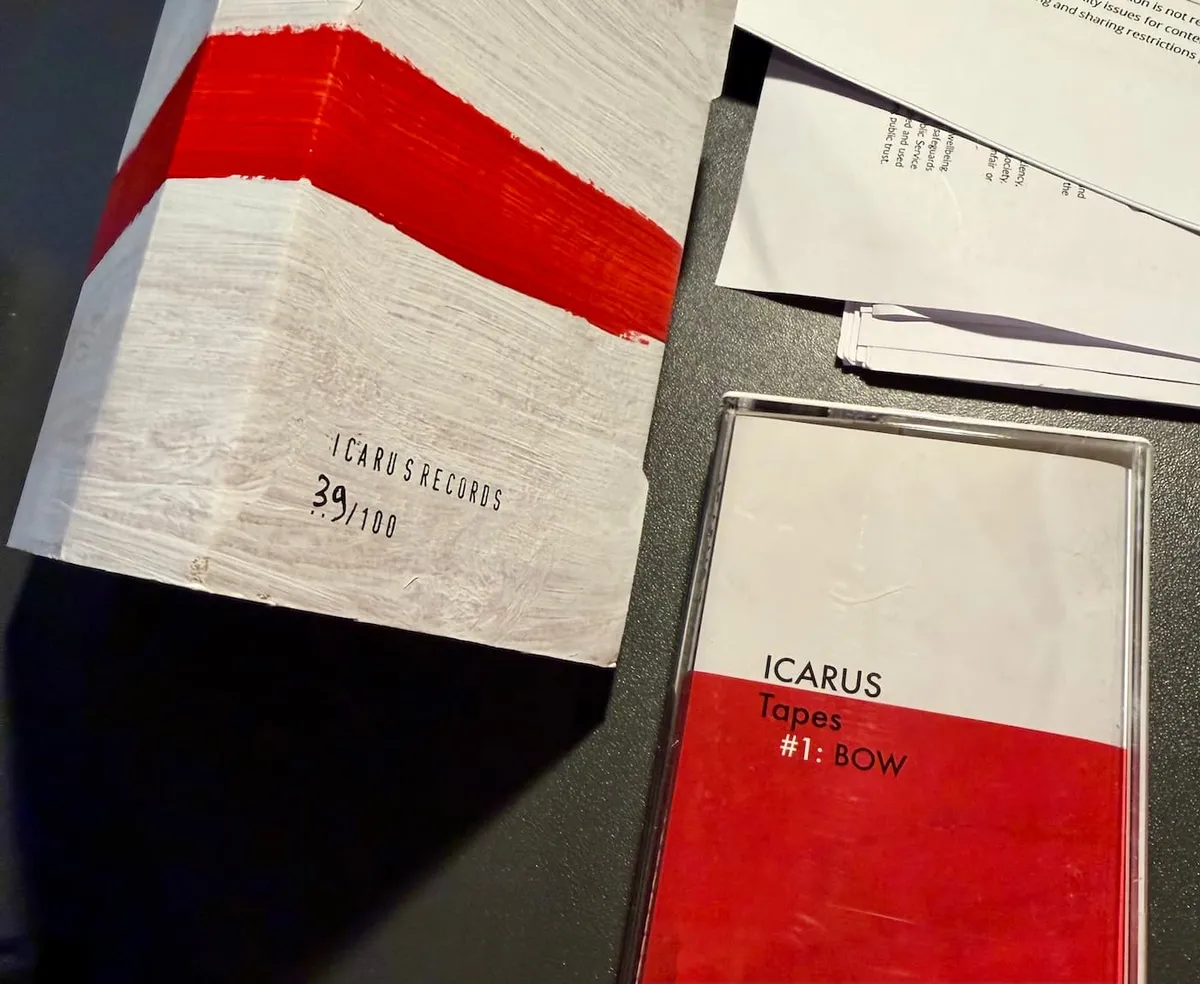
What's really nice is this came in a hand-painted red and white box which matches the cover design and I got cassette number 39 of 100. It was sent by Cyrille de Haes, the double bassist – an instrument I sort of play, kinda. And where does he live? Brussels. And which of the 19 municipalities in Brussels does he live in? Oh, only Forest, the very one I lived in. Cyrille, as an aspiring double bassist and your ghost neighbor, it was a pleasure to get your tape.
When I was scoping out to get a double bass I went to a workshop maker/luthier in Forest, Denis de Fauconval. I thought it was going to be some fancy lad with a cravat from the conservatory but no he was just the most regular craft-working dude you could imagine. Smoking a rollie and his moka pot coffee on the go and all sorts lying around. He had these amazing collections of double basses he was working on, just the most beautiful lineup of instruments I've ever seen8. He also makes viola da gambas, which are a like cellos, a bit smaller, with frets, they actually precede the violin and the viola and he had some knocking about.
Actually, now that I remember it, when I lived in Forest, I had a housemate for a while from Germany. He was just a really smart, nice, hardworking guy, great French speaker too, I think he moved off to Chile? He was called Martin. But he had a double bass in the flat in Forest and that was the first ever double bass I tried. And years later, I got sent this tape by the double bassist in a group and he's living in Forest and the recording is in Ghent by the Shelde river, the river I also lived beside. This is like destiny! Maybe me, Cyrille, Martin, Dennis, we could get together, talk double bass? Guys? Guys, what do you reckon?? Come on, let's start a WhatsApp group.
All right, what were we talking about? Ambient, let's move on.
Side B (ii) – metaxu
The next track is from Ireland – ahh, the auld sod. This track is something of an art-field-recording with accompaniment or tones added to it. The speaking comes in and fades away in a what feels like a memory. I’ve listened a good few times and I’m not entirely certain what's going on. It's like some girls are out in Dublin and they're trying to find a sound – a ‘sonic mystery’ she says. They say they're by the Liffey and by the seafront, maybe they're in Ringsend?
You spend enough time editing audio and people’s speaking voices and it’s great when you hear a voice that has a melody to it, especially in repeated little snippets. The main girl here, she's good, she has a lovely voice and she says ‘mysteryyyy’ – you'll hear in the middle.
The album Tuam na Farraige is:
a collaboration between five musicians, producers, writers and visual artists as metaxu.
…
This electronic and folk music soundscape represents a journey through waking life and the realm of dreams. There are moments of hyper vigilance and focus, hedonism, abandon, rising epiphany and quiet reverie. Blending compositions, field recordings, live gig performances, traditional fiddle tunes and spoken word we unearth common ground after solitary meanderings. Streams of consciousness flow creating a sonically expansive and spacious pool where melodies and words rise to pass. The title, Tuam Na Farraige, is borrowed from a tune composed by 19th century fiddle player John Mhósaí McGinley of Glencolmcille. It’s a beautiful descriptive piece where music surfaces in response to the sound of the Atlantic and finds expression in the first awake moment.
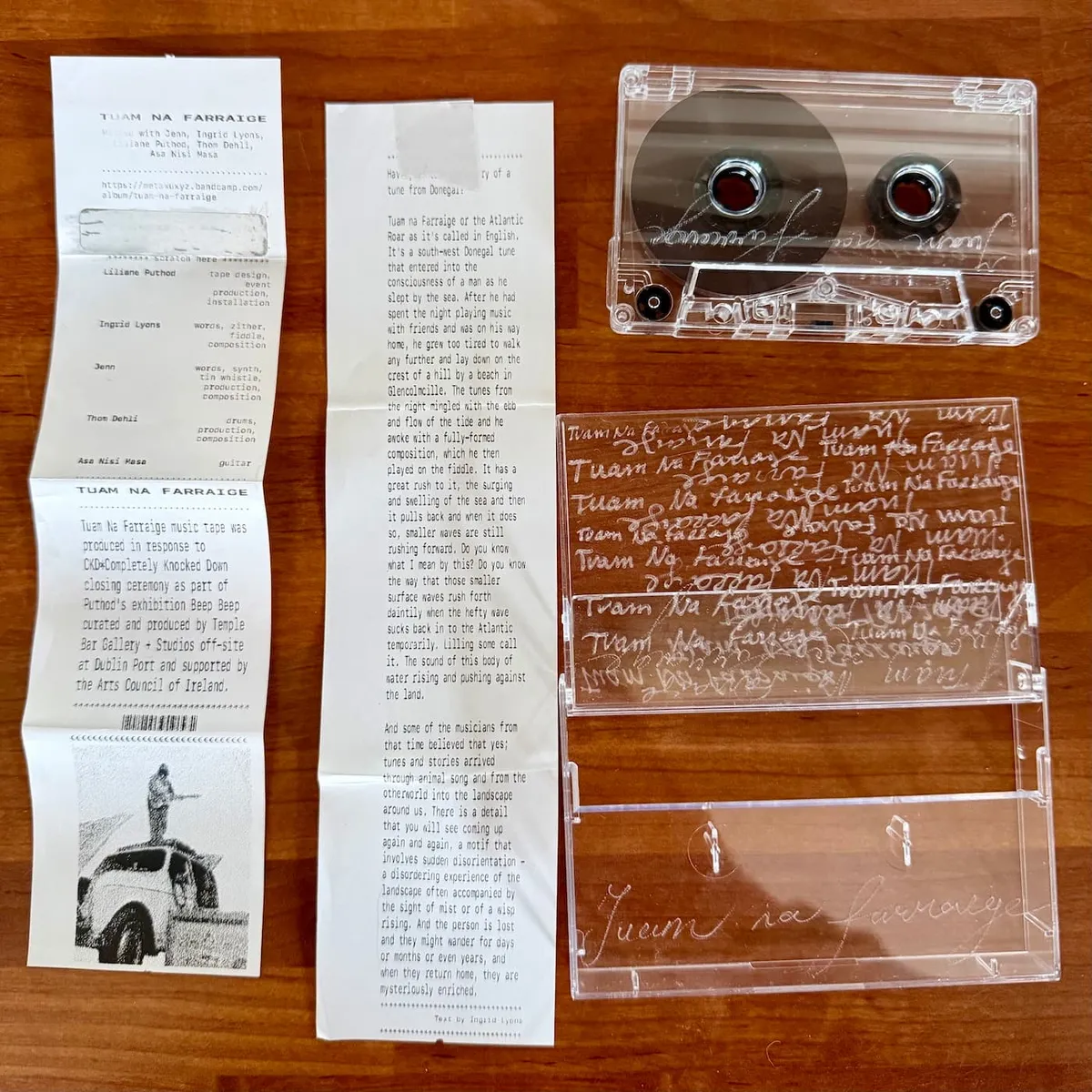
I think it’s the coolest cassette pack i've ever i've gotten. It has stickers, a car air freshener, the liner notes are printed on a receipt using a proper receipt printer, it has a scratch and sniff sticker in there as well to evoke the sea, and the writing on the tape is in typex but in a very stylish calligraphy way. They say that 50 of these tape packs have been made and they're still on sale. I think it's such a great piece as an object to own, to actually hold. And I was happy to put the stickers from it on my tape deck. The whole album just washes over you as a like sound piece, some of it is very calming, some is very abrasive. Just a great piece of art by these people.
As mentioned, the notes are on receipt rolls. The first one gives info about the people involved and how it was part of an exhibition from Temple Bar Gallery and Studios off-site at Dublin Port. Also the artist info:
Liliane Puthod: tape design, event production, installation
Ingrid Lyons: words, zither, fiddle, composition
Jenn: words, synth, tin whistle, production, composition
Thom Dehli: drums, production, composition
Asa Nisi Masa: guitar
The backstory is that Liliane did a piece where where she drove her late father's 1962 Renault to Ireland and put it on display inside a shipping container and Ingrid went along with her too. Also on the second receipt with the tape:
Tuam na Farraige or the Atlantic Roar as it's called in English. It's a south-west Donegal tune that entered into the consciousness of a man as he slept by the sea. After he had spent the night playing music with friends and was on his way home, he grew too tired to walk any further and lay down on the crest of a hill by a beach in Glencolmille. The tunes from the night mingled rith the ebb and flow of the tide and he awoke with a fully-formed composition, which he then played on the fiddle. It has a great rush to it, the surging and swelling of the sea and then it pulls back and when it does so, smaller waves are still rushing forward. Do you know what Imean by this? Do you know the way that those smaller surface waves rush forth daintily when the hefty wave sucks back in to the Atlantic temporarily. Lilling some call it. The sound of this body of water rising and pushing against the land.
When you have music like this it’s hard to pick apart what you like about it. There's an accepting that you, your background, your upbringing, your subconscious, is really making the choice on whether the music sticks. Not that anyone logically chooses the music they like but it’s especially with these types of sounds.
To go down the rabbit hole, I wondered what was up with the name ‘Asa Nisi Masa’. Turns out they're a musician and dj but the name comes from a Fellini film, 8½. The film is about a director, Guido, who is struggling with the point of what he's doing in his life, his work. And there’s an important scene that dives in to the phrase, written up on this film blog, Jabberwock:
Around 40 minutes into the story, at a vulgar filmi party, a magician presents a lady with clairvoyant powers and demonstrates her ability to read the thoughts of people. Guido is sceptical but agrees good-naturedly to be put to this mind test. The lady studies him and then writes the words “ASA NISI MASA” on a slate. The magician asks Guido if she’s got it right and Guido, a contemplative half-smile on his face, says a quick “Si” (Yes) and turns away. “But what does it mean?” asks the magician, and Fellini cuts to a brief flashback of Guido’s childhood. “Asa Nisi Masa” is revealed to be a chant the children would utter after being tucked into their beds, a chant with the supposed power to make the eyes of a wall-portrait “come to life”.
Ooooooooooo.
The film is saying that us as adults, we are motivated, captured by, the things deep down in our own minds, childhood memories even, and we find hard to pick apart why we feel or act certain ways. I can read blurbs and try to talk about music or what is going on but we just sometimes have to, especially for non-obvious music such as this, just accept it. Let it dig up whatever thoughts you want, let it do the work and just see where it takes you.
Houses Tilting Towards the Stars – akira film script
That is from akira film script, who is Ryan Watts, living in Virginia, the United States of America. It's on the album Data Sonifications, on the same label as the deeb album earlier9.
From the album page:
"Data Sonifications" is composed using the OP-1 Field and draws from source material based on sonifications from the NASA Hubble Space Telescope. Through a combination of sampling, synthesis, and field recordings, the album explores representations of the universe—our view into its past from a singular vantage point within the cosmos—and the experience of those who are able to observe it.
A sonification is when they take data from the real world, some sensory info, and turn it into audio. Why? Because, well, you can look at a graph or a spectrogram but your ear can pick up a lot of different information quickly. Plus, maybe your working and your eyes are busy elsewhere. A really simple example is in those submarine films where they have a radar of incoming ships and it speeds up as the enemy sub comes closer: whoot……whoot….whoot…whoot..whootwhootwhootoooooott. Also there's a Kraftwerk album, Radio-Activity (such a good album, my favorite Kraftwerk). The opening track is called Geiger Counter and that uses a… geiger counter, an instrument that measures radiation, and it makes a clicking sound.
When I searched ‘sonifications’ the first page is a NASA site showing examples of where they turn images from the hubble telescope of constellations, stars, galaxies, and nebulae into sounds. I wonder did Ryan get it from there? Cool stuff though.
Recently – Jogging House
Now we exit the shuttle. This is the last one, it's probably my favorite of the lot. It's from our Frankfurt friend again, Jogging House, who opened the show. This track is called Recently and on his Lüften album and the cover is a photo of a forest at dawn/dusk – which just really suits the music. The blurb is: “A sonic stroll through the woods. By yourself, but not alone. Take your time!”
I get a real pang of nostalgia, of wist maybe, listening to this. Do you ever take a holiday or weekend away and you go see a friend, good friends and you hang out with these people and you're on the flight back and you're looking out the window and you're very content, you're happy, but you're also kind of…burnt out, a bit fried? Maybe just a teeny bit of anxiety there? It's a sheer sense of a glistening, sharp, contentment. It’s all going well and then this strong memory comes in and it kind of overwhelms you, you feel a bit emotional, and it passes. That feels like these drone waves that come in periodically. You're very content but maybe a little too content.
Does that make sense? Okay, that's a bit overwrought maybe but it's very hard to describe why this music is good! But maybe the mysterious, unknowable nature of it, maybe that’s the appeal.
So just enjoy. Just be, just be.
Farewell friends. Thank you.
There's a cool branding thing going on where all the album covers have the same style and fonts but just different colours or background photos.↩
It's also gotten really popular with streaming services. People stick on playlists on Spotify like “Ambient chakra-alignment study beats” or whatever fucken genAI slop that has a billion streams.↩
One thing I’ve learned in learning bass with a teacher is you can keep zooming and zooming into songs. I once spent two hours trying to get the bass right on one bar of ‘What's Going On’ by Marvin Gaye and there's hundreds of bars in that song.↩
Reminds of the time a couple of friends of ours were playing tunes in a pub. There were some Germans also there but they were intently looking at our friends as they played, treating it like an actual performance. And we were there, you know you're supposed to ignore them and just drink pints and shout at each other and half ignore the music but then clap at the end?? You're not supposed to actually listen to this, you weirdos.↩
Turns out they're in Dun Laoghaire. I was down there recently at the Bord Iascaigh Mhara offices no less – should have called in to Farpoint Recordings and said hello, I’m sure they love drop-ins.↩
I do like the guitar solo on St. Elmo's Fire. That is fucking class. Although Robert Fripp did that. It's also the same guitar as Hammond Song’s by The Roches. Shoutout to Robert Fripp.↩
I lived there for three years and never heard of them as I was absolutely nowhere even close to some kind of music ‘scene’, or cool things like this happening in Ghent. All these alternative or different musicians around and I never heard of them. I would have wanted to go. What was going on? I felt I would have gone. What did I do there? Did I see art? I guess I went to the laundromat…and the pub? Just don't know really. Mad, isn't it.↩
The double basses though, man, they were spicy enough. They’d be a few grand or so. I was looking around and picked up one I liked, this dark wood, beaten up one. And I was there, oh, how much is this one? And he goes, that one…is Hungarian…that’s…8 and a half thousand euros. I was like, ohhkaayyy, let’s put that one right back.↩
I think I ordered them at the same time? Probably to save on postage.↩