Side A, Track One
Listen to the episode on Mixcloud
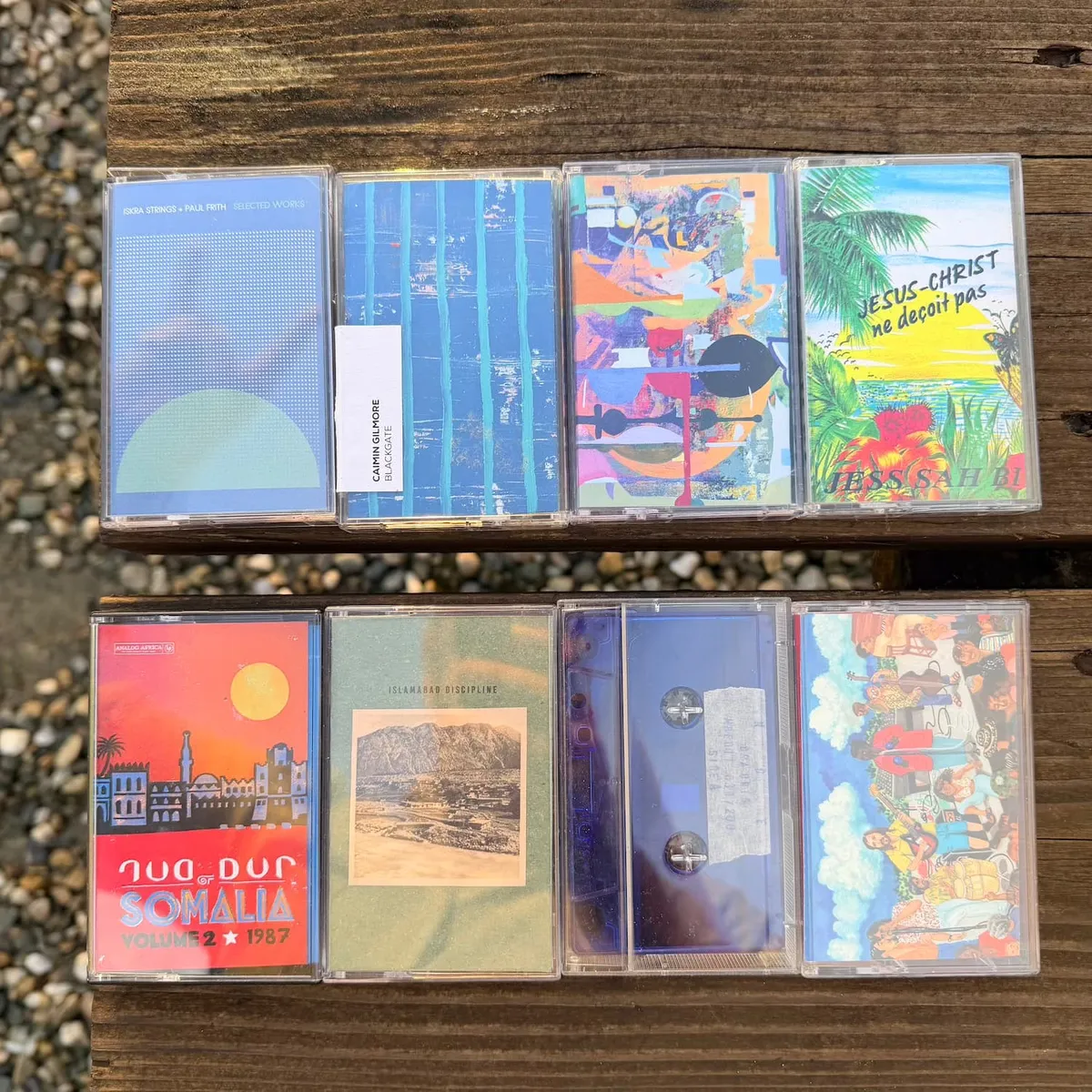
Here we go. I was trying to think of what tracks to select for this episode. And I had the bright idea of going with side A, track ones on tapes I own. It’s the first episode and has a good ‘starting gate’ aura.
Number Six – Iskra Strings, Paul Frith
The first song is by an outfit called Iskra Strings and the track is called Number Six. There’s two albums of selected works by Iskra and this is the first one off the second album and that’s called Number Six. Does that make sense? The main man behind it is a fella called James Underwood. He’s played with a bunch of contemporary people like Vampire Weekend, Sufjan Stevens and others.
I bought the album on Bandcamp, like I do for most tapes, and he sent me an email. He said:
Thanks so much for the support. I posted the cassette today. Please let me know if there’s any problems with its delivery.
Thanks again
J
That’s nice! Thanks James! Now, I guess it could have been some admin he had with the initial J., but I’m going to choose to believe it was him.
At this point, you’re probably thinking, tapes..really? Is vinyl not hipster enough for you? And you had to go one step further?
And the answer, of course, is yes.
Some people said, oh, is this a nostalgia thing? And honestly for me no. I just like them now and I find it hard to say exactly why. But I’ll give you three reasons why I like buying the ones I buy.
Reason one: They’re cheap and I love a good deal. Christ, viynl records would be about 40 euros? Sometimes 50. You get a nice tape for €13. Tapes are nice to have but they’re also a bit, you know, crappy. You can’t really go oh, my precious cassette because it’s just a stupid piece of plastic at the end of the day.
Reason two: I like the sound of interacting with them. The chunk, click, whirr. All those sounds when it goes into the machine when you’re rewinding, when you open the case, when you hit the tape off the table. Records seem a bit stressful, you put the tiny little needle on the exact point. CDs you have to hold in this weird way like a donut and they scratche easily. Just not as tactile.
Reason three: A person sends you something physical in the post. There’s lots of little record labels out there they’re doing all sorts of interesting things. You can email them, they’ll email back, they might put a few stickers in the envelope, it’s just nice. Like the other day I got a tape from Hidden Bay Records, a small record label in Toulouse in France. And they also sent written on a piece of paper and it said:
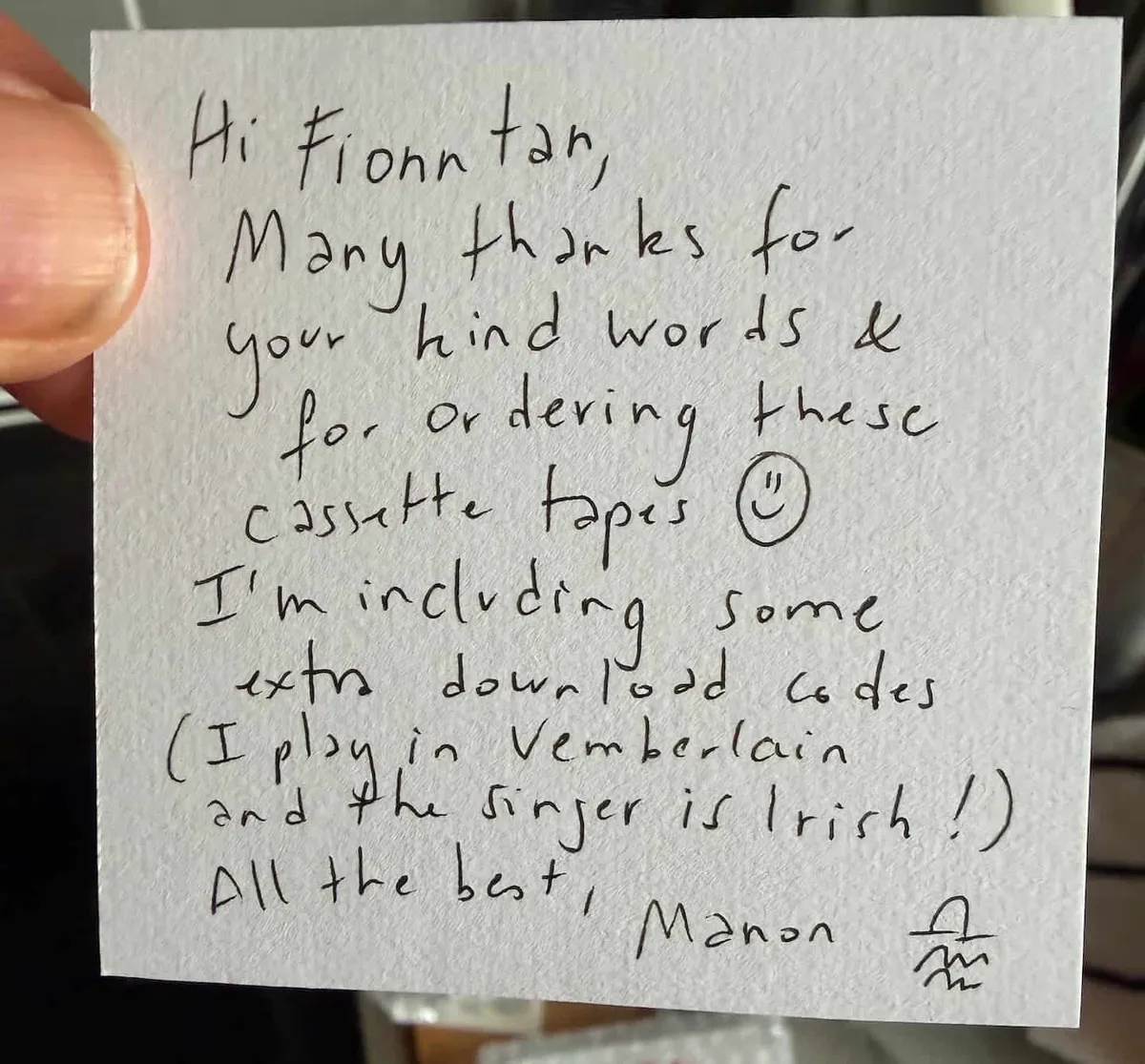
Thanks, Manon!
MVE I – Caimin Gilmore
Keeping up with stringed classical music vibes but not... boring classical music, the good stuff1.
This track, and somewhat the previous one, has that Philip Glass vibe. That kind of: ba-NAH-ba-NAH-ba-NAH-ba-NAH, diddeldiddeldiddel-AH-AH-AH-AH.
I picked this up in an actual shop talking to an actual person in the actual three-dimensional world. I got this in Dublin as I was wandering around Temple Bar2. I was mooching around the area feeling sorry for myself. I went in to Spindizzy Records and bought a few tapes there. The friendly folks there, they said I should also check out this other shop also for tapes. And so I went to the other shop and saw this small rack of new release tapes. In this rack, I saw this blue covered tape and I was asked, who’s this Caimin Gilmore? The guy who works there is young, he’s kind of a archetype record store guy3 . He says this Gilmore fella, he’s a classically trained double bassist and the album is a jazz-classical affair, it’s really good and worth picking up. He said Caimin plays bass for John Francis Flynn, who’s this lovely big man. I saw him gig in London before and he does a very good version of Shallow Brown.
Something clicked in my head, and I thought, folk…double bass… and I realised it must be this amazing virtuoso double bassist I saw play along with Ye Vagabonds when I saw them in Gweedore with Sean. The folk stars aligned.
I think this was the first time someone in a shop recommended me a piece of music to buy in maybe…20 years? Nice thing to do, have a conversation with a human. Who would believe it4.
Knock Knocknarea – White Sage
I don’t know a lot about White Sage. A Dub making music in Sligo, about Sligo, if you can believe such things. It’s good ambient vibes here – just imagine you’re out in the countryside, think of it that way. It’s eight minutes or so, so give yourself somewhere to relax, enjoy, take it in, be somewhere else spiritually.
The album is Queen Maeve’s Grave and it’s:
Recorded around a space jaunt to the west of Ireland & a serendipitous trip down the mountainside of Knocknarea (where the title track was first performed) in 2023.
We were around that area two weekends ago in Sligo, lovely spot. Was supposed to go up to Queen Maeve’s grave but it was pissing rain as it would be in the west of Ireland.
The artist is White Sage or Andy Walsh who I guess was in Sligo for a bit and wrote some good vibes music. He describes “this music is a dream way of music to ride your bike to”, which is a lovely description.
Ile De Gorée – Jess Sah Bi
We could do with some singing. Next up, we’re heading over to West Africa, to Senegal. At this part of Africa there’s a little jutting peninsula. That’s Cape Verde. And on that peninsula is Dakar, which kind of hooks the end of the peninsula. And right in the bay is an island called Gorée Island, or Ile de Gorée. This island is of great historical importance. It was a major, major historical hub for the slave trade for hundreds of years5.
Jess Sah Bi has a fascinating story behind him. He’s from the Ivory Coast and he was in a duo with another fella also from the Ivory Coast. They had this big smash hit and were going well until in the early 90s Jess becomes extremely ill. He went to this evangelical christian place and whatever they did or whatever way they prayed, he became better. In the depths of his illness, he promised he would make devotional music to God. He says:
“Their prayers helped chase out whatever demons and unhealthy spirits were inside me. After that my illness went away. When I went to the United States a few months later on an exchange program I wanted to make music to thank God because I was saved.”
That’s a pretty good reason for making music.
Later, he’s on the music exchange program in South Carolina, of all places. And he needs $600 to make this album, his God album. However, to raise money, Jesse is also a talented cartoonist and he gets paid by Unicef to do cartoons. And uses the money to go on to record the album. After that, he goes back to Ivory Coast and he becomes the country’s first political cartoonist. Eventually causing so much of a national stir with his cartoons he had to flee the country. What a life.
Getting back to Ile de Gorée and the song. It’s obvious to say, but a place of profound misery. But in it, he sees a perseverance, a kind of getting through and a belief, a belief in bettering… God, love, whatever you want to call it, that can carry people through. A belief in liberation of African people the world over.
It has the lyrics in the tape sleeve. So I took a photo of the lyrics and then put the photo in a translate app and pulled the lyrics. Here’s some I think are particularly poignant:
Remember the island of Goree,
the island of sorrows,
where Africa bled into its skin.
Handsome princes and proud uprooted warriors
sold by weight like cattle.
Bullets crackle, black children fall
In South Africa, in America.
Oh, black people of all oppressions, from all horizons,
Your love for God will conquer this world.
Jaceyl Mirahiis – Dur-Dur Band
Jaisal Marhalis means ‘Fruits of Love’. I’m potentially cheating here but this is the second real track after an intro on Volume 2, buy hey, who makes these rules.
Dur-Dur Band were kicking it on the streets of Mogadishu in the 80s. It’s released by Analog Africa in Germany. Through various connections they tracked down the original band members and found the old tapes and got them remastered and re-released them, much to the joy of hipster jerks like myself worldwide.
There’s a nice interview of one of the members of the Dur-Dur Band in the notes and it’s a great story, it’s all very heartening.
In the liner notes there’s two stories I like, which sets the mood of 80s Somalia.
“For the following four months played in each and every corner of Mogadishu, accepting any kind of deal until we received an offer from Bar Liido which was a milestone for us, especially since the gig had been advertised in Xiddigta Oktoobar (October Star), the government newspaper. But that advertisement was a double-edged sword because at the end of that gig we received a visit from a moody military officer holding a copy of the newspaper, “Gor-Gor (the eagle) is the emblem of the army” he shouted, pointing to the advert. “You´ve been ordered to use something else” he continued, before leaving as quickly as he had appeared. We thought of something that sounded similar to Gor-Gor and came up with Dur-Dur, which means ‘water stream’ in Somali.”
The other story I like is:
“We recorded Volume 1 at Jubba Hotel´s nightclub in one afternoon and it was the tune ‘Yabaal’, sung by Sahra Dawo, which became the hit of the album. It’s a traditional song but the way it was recorded and arranged was very different to anything else recorded in Somalia at the time. Our technician Ahmed Dahir made 6 copies of the master cassette which Isse then distributed to the main music shops; Shareerophone, Shankarphone, and Iftinphone. The master cassette would then be used to generate multiple copies. A customer would walk in, ask for three cassettes, wait for a few minutes while the tapes were dubbed at high speed and walk out with the music. It wasn’t high-end distribution, but it was enough to spread our sound throughout Somalia.”
I just like the idea of just people sitting around for five, ten minutes, waiting for their cool tape to be ready. Hanging out, chatting, shooting the breeze in some record shop in Mogadishu in the 80s. I want to be hanging out in that time in that place. I want to be chatting, getting my record, get my tapes.
Aankh Micholi – Islamabad Discipline
Ankh Mekholi by a Pakistani-French fellow Islamabad Discipline. The blurb:
Islamabad Discipline is the project of Pakistani-French musician and educator Ambroise Yon, a kaleidoscopic exploration of his cultural heritage filtered through a collage of field recordings, guitar mantras, and experiments in traditional forms influenced through his studies with the late Ustad Mohammad Ajmal Khan.
It’s on a record label, Radio Kijaban, who are in Tilburg in the Netherlands. They release music from South West Asia and North Africa (the SWANA region). And good for them. Keep it up. I say, prachtig musik jongens! (I don’t know if ‘jongens’ is the right word, I think that means children, whatever lads is in Dutch, really, that’ll do.)
NDE* – Ora Oris
This is also a bit melancholic but hopefully that’s lifted by the good backstory here.
What I like to do in Bandcamp is I filter for cassettes for sale and then I browse through different countries6. I was looking through Italy cassettes and I came across this one, MBE series that sells a lot of old compilations. They say:
MBE stands for “Mixed By Erry” a mythical and somewhat anonymous pirate figure within Naples called Erry with no clear ties to music who issued a series of low-key cassette mixes in the late ’80s and early ’90s. Each of these cassettes came emblazoned with the phrase: “The ideal dimension for a clean listening”.
And so this particular tape, they’re curated by a fellow called Giovanni Napolano (Napolano! In Naples!) He seems to be a DJ. And I have number 11 in the series. The rest are sadly sold out. It comes in this electric, slightly see-through dark blue cassette. The writing on it is a piece of masking tape stuck on saying ‘NDE Aura Oris’. My tape is number 30 of 200.
NDE, going farther down the rabbit hole, is this guy, Nino del Eche, who seems to be a prominent enough Spanish musician (he’s got a Spanish Wikipedia page).
The blurb talks about this vocal technique called melisma. Which is singing a lot of syllables over one word. The example on wikipedia is ‘Angels We Have Heard On High’ – Glooooo-ooooo-oooo-ria…in excelsis...etc. Probably extremely common on football grounds, things like that. We, me, I, Ireland, Irish people would know it from sean nós singing where they go up all around the note.
The page for the tape says:
Melisma is a vocal technique in which a single syllable of text is sung over a sequence of multiple notes. Rather than moving from one syllable to the next quickly, the singer stretches the vowel sound across a long, ornamented melodic line. This creates a flowing, expressive, and often trance inducing musical effect.
Melismatic music is widespread across the Mediterranean, from popular folk music to liturgical chants mainly influenced by ancient Greek, Near Eastern, North African and later Byzantine and Arabs cultures.
And then a quote from Niño De Elche:
“A melisma repeated many times is a good summary of the trance to which popular singing and its music lead us, where not only the vocal expression becomes a reference, but also the dances and sounds with their violences, terrors, and celebrations.”
And so this is the first track on that tape. I don’t have a feckin’ clue who it is, none of those details provided. Class melisin’ though. Keep up the melising, folks.
La Policía – Meridian Brothers & El Grupo Renacimiento
Gonna end this on a fun vibe with these fellas. It’s definitely that kind of South American, Latin American, party vibe but maybe if it was on a cruise ship and you had a few too many drinks and you’re feeling a bit woozy but the party’s still good so you reckon I probably can just drink through this nausea and it actually works and you have a good time.
Meridian Brothers are this kind of weirdo cumbia outfit from Colombia. From what I can tell from the notes, they are paired up with a group called El Grupo Renascimiento, who fell on hard times and have been revived and putting out good music again.
This goes out to Edel, remembering our lovely honeymoon in Colombia, exactly around six years ago. And here we are now.. in Donegal coming out of winter. Take me back, Meridian brothers!
All right, hasta luego agus slán go go fóill.
I’m not the biggest classical guy. Sometimes I hear a classical tune and I think, this is great! Bravo! And that I’m now gonna really get in to classical and be a better person. Then I put on LyricFM for 20 minutes and some opera comes on and I’m just there – oh God I can’t handle this anymore, this is too smart for me, I don’t have the education. I’m sure there’s an entire modern alternative or interesting classical world that I don’t know about. But, well, doubt I’ll learn.↩
I was also incredibly hungover after our office Christmas party. 41 years old and an open bar is just a dangerous mix. I was so hungover I paid into a cinema just so I could have a nap. It was a 70s French movie where this guy murders his mistress – a real broody, slow-burner. I sat in the back and dozed pathetically. Juste avant la nuit. It was perfect for my needs.↩
Maybe the record store guy vibe is just someone who seems hungover - probably was also hungover. Just tired by your questions. There’s someone nice underneath but he’s just had enough today and is grouchy.↩
I did then say to the record shop guy – actually, I just started double bass. And he gave me this look that said – do you know how many middle-aged schlubs come in here talking about their failed music dreams?? Ahaha. I quickly got out of there, went to Kate’s house and had some tea.↩
I only learned about this because of this song on this tape. Which you might think, the only reason you found out about this world historical important place was because of some shitty tape you bought? And yes, that’s actually the case.↩
Usually in the EU. I talked about a good deal before. I bought a 12 euro cassette from England and I got charged €9.50 in customs. 9.50! Anyway, after that, it’s nearly all EU.↩