Lore from the Nore
Groovy, unbelievable, bizarre and unprecedented music from the archives of the Kilkenny Electroacoustic Research Laboratory.
Audio
Article
In this episode
- Water, Bottle, Father, Mother – Jacinta Delaney
- Experiments No.36c & 37a – Eoghan Comerford
- tuvahompi (Second Movement) – Packie Bolger
- An English Country Garden – Oisín Ó Croidheagain
- Proposed in-store Music for L&N Homeware and Lifestyle Outlet – Tony Quinn
- Rejected White Mountain Pilot Theme Tune – Davey 'Rinsey' Butler
- RTÉ Approved White Mountain or, The Border Theme Tune – Davey 'Rinsey' Butler
- Medium Waves from Oviedo – Dian Cécht
- Kenny's Well, Kilkenny City, Mayday '71 – Instruction Manual
- Upon The Air Ending – Gerry Duggan and Jacinta Delaney
Water, Bottle, Father, Mother. – Analysis of the Idiosyncrasies of the North Tipperary and South Kilkenny Border Dialects – Jacinta Delaney
Ahh, Kilkenny. City of marble. As the slabs are brought in canal boats from the Black Quarry in Archersgrove down the Nore, a city was built from her stone. A city on the… well, not a hill really, more that gentle slope of grass you get in the park by the castle where young ones used to go off shifting. A pleasant town, an ideal town. Bike lanes and flower pots and amenities and a good selection of food stands of a Sunday morn.
But stop and wait, dear listener. What do we hear?
Past the pealing of St. Canice’s Cathedral bell, past again the pre-recorded roar of animatronic dinosaurs at Jurassic Newpark. Perhaps a stranger and much murkier aural undercurrent passes 'neath the Nore’s glistening surface.
An object blubs up to its surface and washes up on its riverbank. It is a sliotar, split in half, its innard cork exposed, ants crawl on its surface. We zoom in and we see and hear a Kilkenny underworld. A bizarre, abrasive, strange, wild and yet free and romantic movement of musicians that one time was part of this city’s culture.
And this, this, my friends, was the Kilkenny Electroacoustic Research Laboratory.
How do I feel about Kilkenny? Anyone would say it’s lovely. It’s a pleasant town. I’ve been there quite a bit – I’ve been at a 21st and a 40th birthday party there, so that hopefully shows the span of time I’ve been going1.
These musicians, as part of this collective laboratory, were this bunch of freakers, outsider artists, musician-type people. They were in and out of this free-floating collective for maybe the guts of 25 years, making all sorts of experimental music.
KERL, the Kilkenny Electroacoustic Research Laboratory, was informally set up in late 1965 by Jacinta Delaney (1937 – 2023) and Eoghan Comerford (1935 – 2025). They were inspired by Groupe de Recherches Musicales after Comerford visited RTF in Paris in ’64. The initial idea of the lab was to create a regional centre for sound studies, focusing on early years studies, linguistic research and sound technologies.
Through the years they made this huge variety of music, audio, classical movements, audio plays and some of what you can only describe as just fucking around with wires. Some of the tracks are live, some of them in the studio, there’s a huge array of stuff on these collections. And they’re such a wonderful group of people and we’ll meet some of them now.
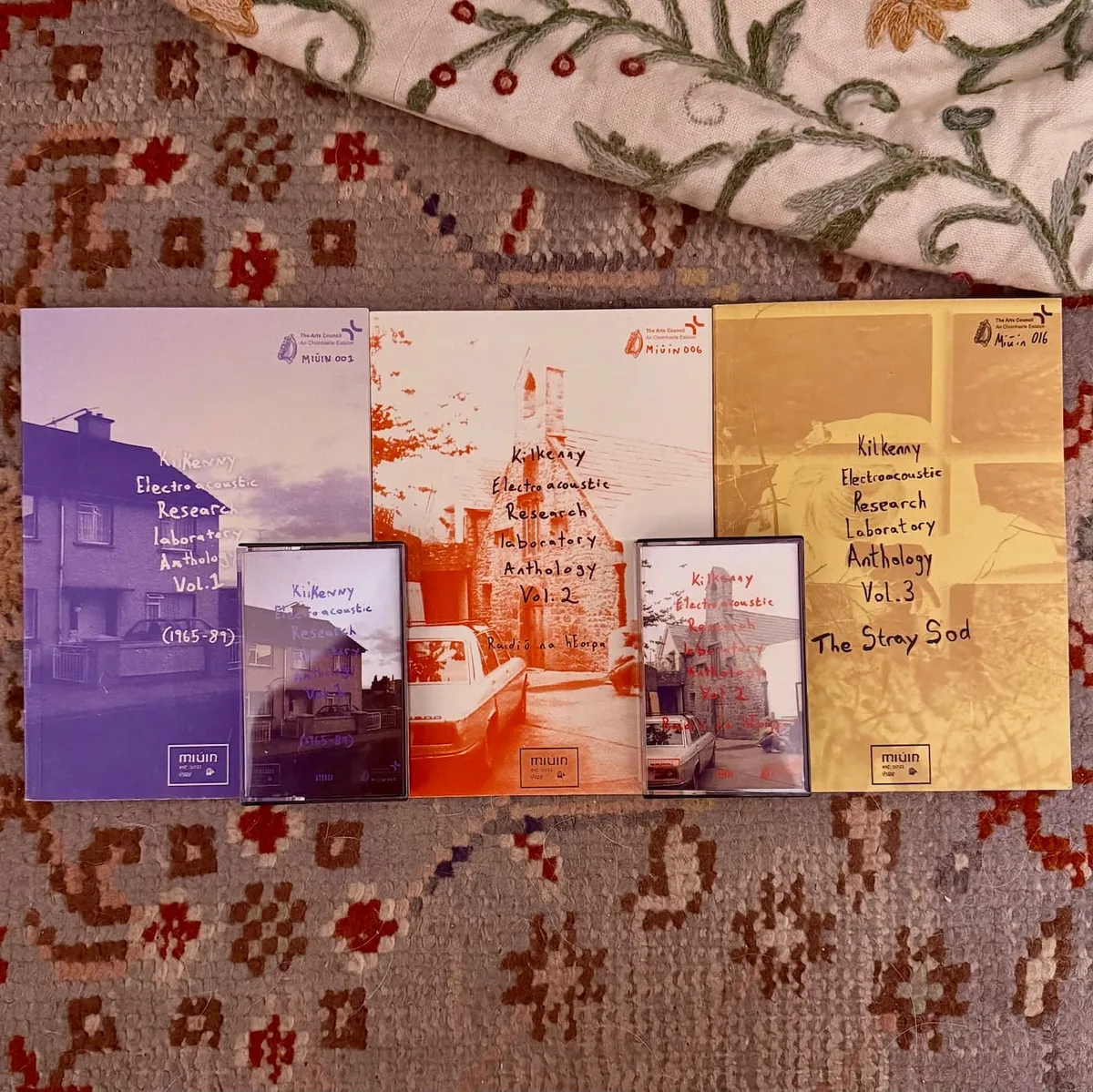
The recordings are in a three-part anthology of the group’s work, brought together for the first time which came out over the last four or five years. Volume One covers 1965–89. Volume Two is called Raidió na hEorpa and Volume Three is called The Stray Sod. It’s all down to the sterling archivist work of Neil P. Quigley, who’s from Kilkenny himself but is living in Scotland now.
But man, just the sheer presentation of these anthologies. You get booklets, restored artwork, advertising, the backstory of the people, newspaper clippings. It’s such a great bunch of physical things to have. And I’m going to say it right at the top of the show: please just go check it out, find it on Bandcamp, go buy it, buy the whole packs, buy the audio, buy the books. And Neil has a label, Miúin, where there’s a bunch of other cool, great music on that as well.
Now, given there’s three albums and about 15 songs on each, I can only talk about a tiny selection of them. I’m going to lean more towards the ones that are more palatable on the ear, the less experimental stuff. To which you’re probably thinking, if you’re picking the nice stuff, what was that shite I heard at the top of the show?
Aha listener, you swine.
That was 'Water, Bottle, Father, Mother. – Analysis of the Idiosyncrasies of the North Tipperary and South Kilkenny Border Dialects' by Jacinta Delaney. These are obviously two neighbouring but very different parts of the country2. It's funny, these borders just completely dominate our lives but really though they’re completely fictitious. And such a border exists between Kilkenny and Tipperary, and affects how they speak, to which Jacinta directed her studies.
I highlight it to show the origins of the KERL but also because it made me remember my speech recognition class in college where we had to do little studies on spectrograms and how each of us pronounced words. It was good fun, so it was nice reminiscing about that.
Jacinta Delaney formed the KERL with an Eoghan Comerford (I’ll play a thing from him later) and they met at a dance hall in London. She was doing post-grad research on early age linguistics and her and Eoghan then moved back to Ireland to set up this research centre. She was doing experiments in audio, especially in early stage speaking and speech synthesis. She saw that in Kilkenny there were a lot of younger professionals settling down, having families, so she started doing these research workshops there. The idea was they might get some public funding and some of these parents might want to send their little Brian or Louise to one of Jacinta’s classes.
However, maybe some of her research was a bit out there, a bunch of local councillors and one particularly thunderous priest type, they just weren’t having it. They were like, who is this one coming back from London with her weird ideas on child development? There was a campaign against poor Jacinta and her 'crazy' ways. She went, right, feck this, and left out the whole kids part and just focused on researching adult dialects in the area.
In the Journal of the Linguistic Society of Ayrshire in October 1972, she had an article: Modern Rural Syntax: A Computer Assisted Study of Regional Language Cultures in the South-East of Ireland'. And this is from the paper:
In this article, I provide a brief history of the area, then theorise about the development of these dialects based on historical and sociological research, and also computer assisted data set analysis.
I then talk in detail about the differences between various modern dialects in this region and how these differences may be explained by factors relating to geography, colonial history, proximity to popular trading routes, such as rivers and roads, and larger, historical class demographics.
My goal through this research is to develop a cross-discipline, wholistic, yet localised, form of language research which utilises history, class and ethnic demographics along with the power of computers and new technologies.
That’s in the late 60s. Man, Jacinta, if you’d only been born 25 years later you could have been hanging out with me and five other geekatrons in the speech recognition class in DCU in the early 2000s!
Anyway, you now know the initial backstory behind the KERL.
Experiments No.36c & 37a (After correspondence with a Mr. Karplus at Stanford) – Eoghan Comerford
Aha, you enjoying this? You might be reaching for that dial, but just hold up, we got plenty of lovely music in this episode too. I highlight these tracks just to show the experimental nature of this group.
Eoghan met Jacinta in London. He was working as a signwriter in Camden but he also had a show on Radio London that was featuring avant-garde music and new and strange pieces. He was from Kilkenny originally and was the one that convinced Jacinta to move back there and set up.
Neil P. Quigley, the guy who put together the anthology, actually interviewed Eoghan in 2023 about this. Eoghan said:
I soon realised that running a lab as a business was a lot of work. I was determined to enable Jacinta to continue her research, so I took the brunt of the admin work and fundraising. I spent the first year acquiring and setting up the equipment – shipping it back from London, realising that it had been damaged in transport and then spending a week or two fixing it. It was a bit of a nightmare, but it developed into an electronics repair service focused on audio equipment. This is how we kept the lab afloat throughout the 60's and 70's. Which was all fine cause I liked the work; I like repairing broken things, chatting to people, connecting people.
He does get around to recording his own stuff. He has a nice environmental recording on the release in particular. But the ones we heard, they were 'Experiments No. 36c and 37a after Correspondence with Mr. Karplus'.
The backstory is, in 1974 there was a big world’s fair, an Expo in Spokane in Washington State (that’s up there with Seattle in the north-west). At this world’s fair there’s a bunch of different pavilions – countries have their own pavilion, cities have their own, and they’re displaying architecture or things about that particular place. At this, there’s an Irish pavilion and the Irish government needed audio for their pavilion. There’s lots of public bodies who get funding who make audio and because the KERL got government funding they asked, can someone contribute some audio elements? Eoghan’s basically the main admin for the KERL and he says all right, I’ll make some audio for you. And so he does. The final work was an "immersive, three channel video, surround sound installation", which he creates with a couple of other artists. Long story, but it all ends up in a kind of bureaucratic disaster in the end a whole complex, woven tale of different needs, infighting, public service mess. It’s worth reading about.
The two tracks you heard, this is good, in the notes for these it said they were in contact with Mr. Karplus. And Neil, who put all the archive together, he thought it was a Stanford professor who was one half of the Karplus-Strong string synthesis but it turns out it wasn’t him, it was actually a national security guy, Milton Karplus, from the Hoover Institution in Stanford3.
There’s a nice piece where Neil interviewed Eoghan. Eoghan actually drifted off from the collective in the end but in this he’s talking, reminiscing even, about something another member, Kenny Phelan, said to him, making this analogy with water divining:
He once said - 'Some people actually believe that those little rods are imbued with some power or divinity, other dowsers believe that dowsing rods are a sort of conduit, amplifying their nervous system and their connection to the land and nature, but other dowsers believe it's all nonsense but are completely devoted to it anyway, and that's us, we're the third type of people whether we realise it or not?
I think that was Kenny's fundamental outlook on things, and at my age it's the only way of looking at life that makes any sense - to do something you know is utterly preposterous with as much passion and excitement, and love, and devotion as you can muster during your little, insignificant bit of time on this earth."
I think that’s good advice for all of us.
tuvahompi (Second Movement) – Packie Bolger
Packie joined the KERL in 1984 when he came back from New York – he knew Eoghan from school. Packie had been in New York but was there illegally. One day he was on a big drinking session, walking around the city with a friend, and he saw the LOVE statue from Robert Indiana. You probably know it when you see it, it’s a big pop art piece saying L-O-V-E and statue versions of it are in different cities. There’s a version of that piece even on the cover of Renegades by Rage Against the Machine. They made a statue version of it in New York and Packie is walking around hammered and he’s like, argh feck love, feck all this shite! So he went over to go pee on the statue, he unzipped, ready to go and then feckin cops come over, they’re there, hey you! And they picked him up for public urination. And sure, mister undocumented over here, he’s soon kicked out of the whole country. All for a wee. Rough one.
Packie apparently was in some experimental music scenes over there but Neil couldn’t find out exactly what they were. But it is known that Packie did come back for a summer in 1978 and was in a band called Dian Cécht, which was a folk-Celtic jam band. There’s a very good tune from them coming up later, so hold on for that.
This tune though was the first use of the PPG Wave 2 by the KERL. A very good synthesizer brought out by Palm Products, who are a German outfit. You know the sound of it, it was used by Depeche Mode, Tears for Fears, Grace Jones, that 80s synth sound.
Packie moved back permanently and he wrote this six-piece magnum opus. It was a big statement on humanity, that language was breaking down, people were out of balance, they couldn’t talk anymore and it was only through the power of music that people could be reunited. He named the track after the Hopi word for unity or togetherness – Tuvahompi.
Namaste Packie, for that.
An English Country Garden – Oisín Ó Croidheagain (Creegan)
Ahh, a pungent track, I would say.
To wrap up the volume 1 of the anthology, it’s this track by Oisín Ó Croidheagain (Creegan). He probably had a more, let’s say, commercial kind of view of things (particularly as there was a tax exemption going on for artists). He was in the housing sector, he worked as a foreman, he did some bits on housing for the council. He joined the KERL and Jacinta and Eoghan trained him up in using the equipment. He tried to write a few tunes himself but he gets nowhere really.
But then what he does, kind of slyly really, he just orders some MIDI4 files from a postal catalogue and puts them into the synth equipment that they have and then the synth plays the music and he’s like, great! I can release this. And Oisín put out tunes doing just that.
Now, this was almost certainly a money grab but maybe let’s take the artistic view of this. Maybe it’s a form of pop art? Maybe it’s a mechanical reproduction at scale of an art piece? This was back in the 70s before copying files or MP3s or whatever. Maybe you can be a middleman, a buyer, seller, trader of music, almost like an importer-exporter? It’s interesting to think about what Oisín’s doing here.
Oisín was not quite in the spirit of the true romantic Gael, his track here is called An English Country Garden and he released this song along with another track on a record called 'Electronic Folk Music from the British Isles'.
He also released a synth version of arrangements by a guy called Aloys Fleischmann. I’d never heard of Aloys. He was a composer and his family were German, although they settled in Cork. He happened to be born in Germany because his mum was a concert pianist on tour and she went into labour and had the kid there. But he moved fully to Ireland when he was six. He was in a well-to-do, well-established family and he got a good education. He went on to be a composer, scholar, conductor. But even though he was very much in the classical world, he was also very much into Irish music, Irish culture and was a fluent Irish speaker. He even had an Irish stage name, Muiris Ó Rónáin. Him and his family were in Cork in the early 20th century, there’s a big Republican movement all around them and he’s totally up for it, becomes, dare I say, a true Gael.
University College Cork have scans of his diaries from when he was 16 and 17 and I like this one from October 9th, 1927:
A week of idleness and misery! Suddenly got the idea, one night when I could not sleep, that I was getting St. Vitus Dance, ((St. Vitus Dance, Sydenham’s Chorea, can accompany rheumatic fever in children, and involve convulsive movements and behavioural abnormalities.)) and immediately my unfortunate head began jumping nervously. Got up with aching brains in the morning and was twitching badly. Perspired with the terror of it, but said nothing and took a lonely and nervous walk to Blackrock. As it continued for some days and I was as bad as ever, so went to the Dr. who gave me an excellent sermon on over-work and nervous imagination resulting therefrom. Went home cured and now can rejoice again in the delights of ordinary life and blessed work. But it was a well-timed lesson!
It seems he got these headaches from chronic overwork but then also when he wasn’t working, he was quite down and melancholy. Which I feel kind of happens to us all, doesn’t it? You get a bit languid when you finally get that free time you so wished for.
I checked him out on Spotify and there’s just one album of orchestral works, performed by the RTÉ National Symphony Orchestra, and sadly there’s not many listens. This is a hero of Irish classical and there’s only two songs with just over a thousand listens. I was pleased however to see that the first track on that album is the Four Masters Overture. The Four Masters being the 17th-century scholars in Donegal who wrote a 2,500-year history of Ireland up to that point. Also the name of the Donegal Town gaelic team. Maybe they’ll stride onto the pitch with Aloys’ tune blaring out on the tannoy.
There’s a quote from him:
What is needed is a Gaelic art-music which will embody all the technique that contemporary music can boast and at the same time will be rooted in the folk-music spirit, and will be as individual and genuine as that folk-music is individual and genuine.
Aha, compare those stirring words for our nation to the production from Oisín Creegan. Romanticism versus the cold-hearted manufactured commercialism.
Proposed in-store Music for L&N Homeware and Lifestyle Outlet – Tony Quinn
Remember we did an episode on ambient music and there was mention of Erik Satie and John Cage and it was about ‘space-based’ music, as in, music to fit and impact the physical space you’re in? Well, there was a fella who joined the KERL in the early 70s as a sound engineer, Tony Quinn. He became the head tech person of the lab – he set everything up, ran the workshops on how to put all machines together. He was also a commercially minded, although less shamelessly than our pal Oisín. What Tony did was he contacted businesses in different parts of Ireland about creating music that could be played inside shops.
He was interviewed by Neil:
"People started to get a bit of cash in their pockets and were eager to let others know. There was a growing appetite around for nice bits and bobs shipped over from England or Europe and people started taking day trips to Cork or Dublin to spend a few hours walking around the department stores.
I mean, we know now that it was the beginning of the mad sort of consumerism we have now, but at that time it felt connected to looking beyond ourselves. So, I thought - wouldn't it be great to have some bespoke music for each of these department stores that would change from floor to floor and department to department. Roches stores in Cork would have a different sonic character to Clerys in Dublin and so on."
He sent these businesses he was talking to all this American research about music in shopping malls but also stuff on this topic called stimulus progression.
Did you ever hear of Muzak? You know, that jazzy, loungey version of popular songs, it was a thing in the US, you’ve probably seen it in TV shows, especially when they’re, stereotypically, in a lift and there’s this elevator music going on. Muzak was actually a music service provided by a company, founded by a General George Squier. He was in the Signal Corps, which dealt with communication and information systems, and he invented a few patents for wire transmission of music and set up this music subscription service. First it was to an electric power company but then it went direct to high-end customers and businesses.
They have the technology but next they need the songs that they can subscribe out. They hired a bunch of songwriters and conductors to write thousands of songs. From Mood Media’s history of Muzak:
The studio recorded sessions on a daily basis, with each session sometimes capturing as many as twelve tracks in a day. A large variety of music genres were recorded during these sessions. Styles included swing, foxtrot, movie scores, operas, gospel, Cuban, Hawaiian, salsa, polka, barbershop, classical, ragtime, and even early versions of what is now country music.
At the same time, there’s all these studies emerging on the effects of music on human psychology and especially its effect in the workplace. Does it improve productivity, the classic worker-drone questions. Muzak was pushed into factories and other industrial areas to supposedly boost employee productivity.
Now, whether this worked is another question. If you’re ever in a job and they play god-awful radio all day long, just the most inane shit you’ll hear, oh god, soul destroying. Maybe that’s mainly the presenters? Just stick some ambient on for Christ’s sake, that would make people feel calm and at ease in their job5.
From the same article on muzak, they define stimulus progression:
The basic concept of Stimulus Progression is the idea of changing the styles and tempos of music to counterbalance and influence the natural rhythms of the human body. Studies showed that employee production would dip during certain times of the day; before and after lunch, for example. Muzak playlists were then programmed against those patterns by playing more upbeat music during the slower times of the day, and vice versa. The style of music was typically light classical, heavy on string instrumentation, and as non-invasive as possible – all hallmarks of the Muzak sound.
I actually do that. For a few hours I stick on ambient in the work morning, then in the afternoon I listen to more upbeat or active music. I’ve been doing that for years, so maybe there’s something in it?
However, our friend Tony Quinn of Kilkenny, he proposed this in-shop music to a bunch of different outfits and it seems they mostly thought he was a bit mad. But there was an outfit, L&N, he got a bit of traction with. What L&N were trying to do was instead of people having to go up to Dublin or Cork they could bring the high street shopping to smaller towns in Ireland. Like how people from the country would go up to Guiney’s for the Christmas shopping, why couldn’t they be near their own towns? Tony proposed the following music for L&N and he had all these plans for speaker placement in the shops all laid out.
Sadly L&N backed out in the end but the music is really good. How would I describe it? Ever find yourself in some homeware shop or gardening shop on a weekend and maybe you’ve a mild hangover because you ‘went wild’ and had three glasses of wine watching a film and you see all these items and you’re standing there holding some homeware crap and you kind of question things a bit? Like, is this where my life has gone? But then you go, you know what? It’s all right. Maybe there’s contentment there too. Yes, this is it and maybe that’s okay. Maybe that’s okay.
Tony, if I had a business selling homeware, your tunes would be playing in it.
Rejected White Mountain Pilot Theme Tune – Davey 'Rinsey' Butler
In the KERL lab, Tony graduated and became a full musician member and so his engineering assistant gig freed up. In stepped local keyboardist Davey ‘Rinsey’ Butler who started helping out in the laboratory and eventually making his own stuff too.
Davey had an uncle, Fleming, who was a drama and fiction writer. In 1984 Fleming pitched a script for a murder-mystery, brooding police drama tv show – there’s a million of them out there. It was called White Mountain and was set on the Cork-Kerry border. RTÉ picked it up and even commissioned a pilot. Fleming then asked his nephew, Davey, to put together a theme song for it along with some bedding music they could use during the episode.
All was well in TV production land until, well, it turns out station producers and independent artists have very mixed views on what makes good TV. Whoda thought! Davey was interviewed about this in 2006, which is in the KERL Vol. 2 book:
I think it could've been a really great show, but to be honest RTÉ just tore it apart bit by bit. The pilot was made, but from what I can remember, it was a really compromised version of the original script. I remember that RTÉ eventually agreed to pick it up but with big changes. They suggested keeping the two lead detectives but wanted to move the show to Dublin and have it be this episodic, fish out of water, bumbling Cork/Kerry men in the big city type thing. They wanted to cast a different one of RTÉ's "top talents" as a guest murderer every week. I think they were going for a sort of Irish Columbo, but a lot shittier. Needless to say, I don't think he had a great experience working with them.
And that was just the writing of it. Even with the theme tune it was war, just a load of hard work for Davey. He first made a cool, atmospheric theme tune, which had harp, pipes and great synth sound from the lab’s new Ensoniq Mirage around this time6.
The track above was his true artistic vision of what this theme tune should be and then the next one is what RTÉ chose.
RTÉ Approved White Mountain or, The Border Theme Tune – Davey 'Rinsey' Butler
Davey brings the first version to the RTÉ execs and they don’t like it at all, they won’t have it. They say they want something more upbeat. And so it goes over and back, he tries different things, they even start talking about changing the name of the show from White Mountain to The Border. At this point, Davey he’s just getting frustrated, and just as a piss-take as much as anything, he does what he describes as this 'Blue Peter type shite' out of frustration and creates a new version.
He sends it over to them and they go, it’s great! We love it! We want more of this. Gorgeous – that was the word they used all the time7.
Davey describes this whole process in the interview:
During one feedback session, I pressed them a little bit on what they actually wanted, cause I was at my wits end. And they came back with 'well maybe make it more positive and more Irish.' So, I wrote that theme in a fit of anger with the intention to make the most derivative, saccharine shite. But of course, they loved it, and it ended up being used on the final pilot.
A great example of when artists meet the entertainment machine and how the KERL had to interact with the big bad world – almost like some kind of endangered species.
The show never got commissioned for a full series, though they did make a pilot, and some of the script and on-set photos are in the book for this release. It’s good craic, a simpler age of TV.
Imagine in a different timeline we could have been listening to Davey ‘Rinsey’ Butler’s music every Sunday night after Glenroe.
Medium Waves from Oviedo – Dian Cécht
This is the final choice from volume 2 of the KERL anthology and this is just a genuinely good song, a great song even.
Do you remember Packie Bolger earlier? He’s the fella in New York who moved back because of a wee. A few years before he permanently returned, he was back for an extended summer of maybe five or six months and he got together with some old school friends and started making music. A quote from the book:
Like Bolger's later compositions, the music they played was based around repetitive musical phrases and interlocking rhythms, combined with the juxtaposing aesthetics of Irish Mythology and the country's newly constructed conception of its own Europeanness.
Bolger would play numerous instruments in the group including Bass Guitar, Low Whistle, Synthesiser and Uilleann Pipes. They called the band Dian Cécht after the mythological Irish God of Healing.
Now, whether they believed it, the group at least implied that their music had healing energy powers.
Dian Cécht though. Listen, I know feck all about Irish mythology but I like that Dian was a healer, a doctor, of the Tuatha Dé Danann, the ancient gods of Ireland. He built a healing well in the Heapstown Cairn, which is in Sligo now. He did his healing by putting all the types of herbs in Ireland into this well and him and his children, who were also healers, they chanted over the well. And so injured soldiers, warriors, would go into the well and be healed. Do please feel free to get some healing chants going, Dian style.
As for the group themselves:
At the end of August '78 the band decided to record their first and only album entitled Radió ón Eoraip, which was a collection of loosely defined grooves accompanying a series of predefined solos or duos improvising overtop.
There’s a picture in the book of a very nice looking tape that the album was released on. It also has the lyrics from one track, 'Électronique, Microphonique'. This song has a voice passed through a vocoder over some radio static and a collection of weather reports from around Europe. These are the lyrics:
Électronique, Microphonique, Magnifique.
I hear a voice through the radio
I listen in when I'm all alone
They send the signal
From their transmission tower
Calling all stations
On the hour
Électronique, Microphonique, Fantastique.
Now, you have to realise this is probably peak Kraftwerk, Can, Neu! time – it was the summer of signals and trains and looking to the European continent.
This song though from that album is 'Medium Waves from Oviedo', which has a looping groove going, with some solo improvisations using acoustic instruments but put through an echo machine. I find it quite captivating, I have to say.
Kenny's Well, Kilkenny City, Mayday '71 at Cadder Freestone Social Club, Bishopbriggs – Instruction Manual
We’re on to a couple of tracks on the third and final collection in the anthology now. Once again, I note that I don’t have the tape for this volume, I only have tapes for the first two. But I did buy the audio files and book off Neil for this. So Neil, you coward, release the third volume on tape, please. Release the tape you maniac!
Our second last track of the evening is by Maeve Scully, it’s called Kenny’s Well and it’s part of her Mayday Dew series.
Maeve was a folklorist and when she was in college in UCC (same college in fact that keeps Aloys diaries, wonder did she read them?) she had an assignment to create some piece based on nature. She went out to Fitzgerald’s Park in Cork on May 1st and left a blank piece of music paper on the grass. The dew on the grass left marks on the page and then she traced around those dew marks and turned that into a score.
I’m not sure her lecturer was that happy but she liked the idea so much that she did it again the following year and it became a summer tradition for her. She’d go out to the same park on May 1st every year with a blank score, transcribe the dew and then over the next week, she’d head off to the KERL to turn it into a proper piece of music. Her first few attempts at this were fairly acoustic at the start but the instrumentation got more elaborate over the years.
This is an example of aleatoric music. Aleatoric means having an element of chance, or being indeterminate. For instance, if you roll a dice and it comes up a three, then you’re going to play a certain part of a piece music. There’s loads of examples out there. Terry Riley has one, In C. He created 53 short segments of music and a group of classical musicians can play and pick any segment and play it in any particular order they want, and repeat it as many times as they want. So every time it’s going to sound different, depending on what those musicians feel to choose.
The one in particular I like. There’s a Scottish artist, Katie Paterson, she recorded the sounds from three glaciers, Langjökull, Snæfellsjökull and Sólheimajökull, in Iceland8. She got run-off water from each glacier, froze it, and created a record out of the ice, with the glacier’s sound on the record. The idea being that you play the record until it melts. Isn’t that cool lol.
There’s three different recordings of the May Day scores on the KERL anthology. The one she recorded in ’71 was Kenny’s Well. From the book:
Kenny's Well, Kilkenny City, Mayday '71, was realised by Scully on piano and Donny Cleere from the James Stephens String Trio, on violin. It was recorded at K.E.R.L. in June '71. This was her last solely acoustic realisation until the late 90s when she revisited very reduced acoustic realisations.
This piece got well known by a bunch of different acts in the experimental world. The track on the KERL anthology is a Scottish group, Instruction Manual, doing a performance of Kenny’s Well. Kenny, of course, being the big man, Cainnech of Aghaboe himself. St. Canice, St. Kenny. You can visit Kenny’s Well anytime you’re in KK. Just look for Kennyswell Road, conveniently.
I would also describe the piece as space music. Give it space, time, let it breathe around the room. Don’t listen to it directly, just let this one happen.
Upon The Air Ending – Gerry Duggan and Jacinta Delaney
Now sadly, folks, we’re up to our last tune and this one’s a children’s story to round it off.
Remember Jacinta Delaney, all the way from the start? Founding member of the KERL. She was interested in speech and acoustic research in child development. She asked a local writer, Gerry Duggan, to make an educational piece to bring some of her ideas to life for kids. Her aim was to increase, as she called it, the 'sonic literacy' of the children of Ireland and introduce kids to different forms of sounds. The two of them then worked with a local artist to turn the idea into a kids’ book and an accompanying cassette.
I’m going to be honest (and I don’t use this term often) but this book just sounds like a load of hippie shite. But yet, but yet, maybe there is something lovable about it too? Different synthesised elements, say a sine wave or a square wave or certain wave patterns, they became different characters in the story, each paired with their own sound on the cassette. I guess like a dippy electro Peter and the Wolf.
From the KERL book:
For instance, the sine wave was represented by a round green character who was worried that it was too boring. This worry was reinforced by the sound of the character on the audio cassette, which was a plain, simple sine wave where the pitch is modulated by a variable rate LFO. As the story progresses, Otis, the protagonist of the book, helps the green sine wave creature to accept itself as part of a greater whole.
There’s a whole bunch of other characters. There’s the peaceful blue triangle, the angry red square, the confused yellow irregularity. The book for this anthology has the score for the character themes, where for example the angry red square has its own theme on the bass clef.
Obviously this book wasn’t any great success but they did release a colouring book along with it too. It’s just a kind of quaint, quirky, weird, wonderful thing that once existed in the south-east of the country back then. I’m so glad it’s all been brought to light.
The track is the wrap-up and end of that cassette for the book. You’ll recognise a few of the friends we’ve learned about along the way in the credits too.
That’s it really for these anthologies. Please do go out and buy the books, the tapes, the CD – there’s so much great material in there. And just the wonderful people that made up this collective in the 70s and 80s, it’s a real part of alternative Irish cultural history.
How it’s put together, the books, the writing, has a wry funniness to it too. I feel Neil in writing it, has a certain love, maybe affinity, for these people, for this collective. So my great respect to Neil P. Quigley for putting all this together. Presentation, layout, research, interviews. Amazing stuff. There are so many other things I could have picked. There’s so much more to read, to explore for anyone here. Books, songs, experiments, tidbits.
I’ll sign off with the last two lines of a troparion of St. Cainnech (a troparion is a short religious poem) and dedicate it to these beautiful freakers of the Kilkenny Electroacoustic Research Laboratory.
Thou art a tireless intercessor for the faithful.
Pray for us who hymn thee,
that despite our frailty we may be granted great mercy.
Actually, I think at that guy’s 21st, he was held by his ankles over the bridge by Kyteler’s, mafia style.↩
A couple of us here in Ardara were talking about that recently. There’s a family in Ballyerstin, and that’s just on the edge of Narin, and therefore Ardara. And there’s another family, I think they might be cousins of them, and they live in Leitirilly, which is a wee bit away. So you grow up a few hundred metres away and suddenly you’re a Glenties person. You talk Glenties, you support the team, go to the Harvest Fair. All because your folks got a site 500 metres up the road. Your whole life is completely changed from Ardara to Glenties. Mindblowing.↩
I read a good article on the Karplus-Strong string synthesis algorithm. To create the sound of a string you take a sample of white noise, then filter or smooth out the higher frequencies, and then keep repeating that process on a loop. Like on a guitar string, the high frequencies die off quickly. The longer the sample of white noise, the lower the note. I think the computer science people and the freako artists, maybe they have something in common? Maybe I feel a certain affinity for the KERL because of their interest in tech and weird signals?↩
Do you know what MIDI files are? They’re basically a file with a set of instructions for how a machine can play a song. So that same file can be put into multiple types of instruments. It has things like pitch, notes, sustain, volume, pan, and so on. It’s a file standard, it’s been used since the 80s.↩
Actually, I was in Belfast airport a few months ago and I got some deal where I could get into the lounge for 20 pounds. Good deal. And of course I scoffed down as much food and booze as I could possibly fit in me, you’ve gotta take advantage of that. In there though, was this nice, soft, jazz, loungey music played at a nice volume. Something that says, ooh, this is a classy place to be in. But then you go back out to the main hall and it’s just loud, abrasive, shitty pop. And I’m wondering, why can’t the main hall just play the nice soft jazz? I mean, it literally doesn’t cost anything more. I think they’re just trying to amp up the frenetic stress out there.↩
These were keyboards you could load samples into from floppy disks – samples of actual instruments. Nowadays obviously they’re all stored in the keyboard but this was a real breakthrough at the time. What made the Ensoniq even more amazing was you could record your own samples and store them on the keyboard as well.↩
Funnily, that’s what people always call our dog. Gorgeous. I don’t really use the word gorgeous, I don’t think I’ve ever genuinely used the word gorgeous, only to make fun of people who say ‘gorrrgeous’. Although, it is a nice thing to say to someone when they’re dolled up and put in the effort going out.↩
Of course it’s Iceland, artists feckin’ love Iceland.↩